

How to choose a watch: automatic, quartz, or solar (Eco-Drive)
Posted by REDAZIONE GIOIELLI TOSTI
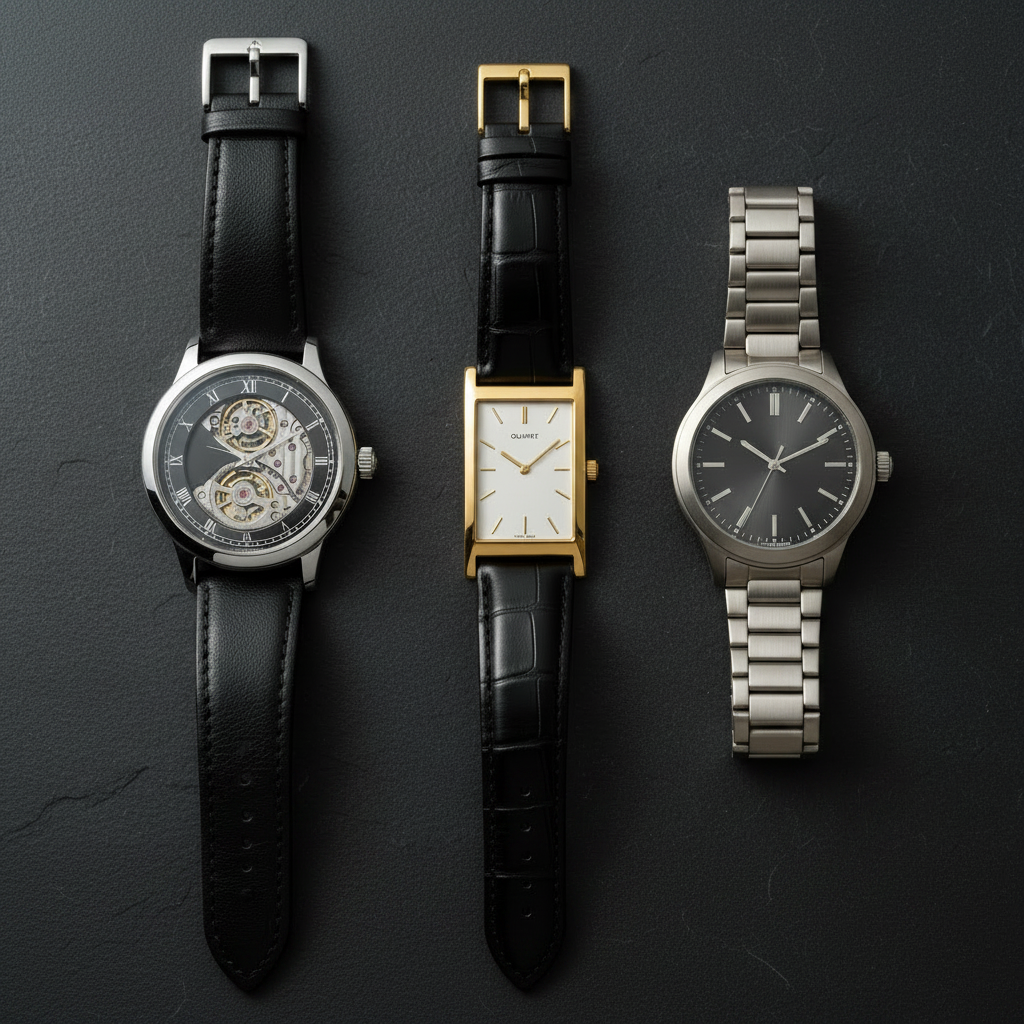
In summary: An automatic watch is wound by wrist movement, has no battery, and lasts for decades with maintenance every 3-5 years. A quartz watch is battery-powered (1-5 years), more accurate, and requires less maintenance. A solar watch (Citizen Eco-Drive) recharges with any light and never needs a battery change. The choice depends on budget, taste, and lifestyle.
Three types of movement compared
| Feature | Automatic | Quartz | Solar (Eco-Drive) |
|---|---|---|---|
| How it's wound | Wrist movement (rotor) | Battery (1-5 years) | Any light (no battery change needed) |
| Accuracy | ±3-15 sec/day | ±15 sec/month | ±15 sec/month (like quartz) |
| Maintenance | Service every 3-5 years | Battery change every 1-5 years | Minimal — photovoltaic cell lasts 20+ years |
| Durability | Decades if cared for | Long, depends on electronics | Long, depends on electronics |
| Entry price | From ~€300 | From ~€50 | From ~€200 (Citizen Eco-Drive) |
| Value over time | Often appreciates | Stabilizes | Stabilizes |
| Artisan appeal | Very high | Functional | Functional + sustainable |
Automatic watch: pros, cons, and who it's for
The automatic watch is the preferred type for enthusiasts. Its mechanism is wound by an oscillating weight (the rotor) that moves with the wrist, winding the mainspring. No battery, no cables: it's a purely mechanical system that has been working for centuries.
How the mechanism works (briefly)
The rotor — a metal half-disc — rotates freely with every wrist movement and transfers energy to the mainspring via a gear system. The spring gradually winds and unwinds, regulated by the escapement that marks time. The result is that characteristic "sweeping" second hand (not ticking like quartz) that distinguishes an automatic at a glance.
Pros of automatic watches
- No battery to replace
- Artisanal value and watchmaking tradition
- With proper care, it lasts for generations — it can be inherited
- The "sweeping second hand" is unmistakable and fascinating
- Often gains value over time (especially prestigious brands)
Cons of automatic watches
- If not worn for 36-48 hours, it stops (requires manual winding or a watch winder)
- Requires servicing every 3-5 years (variable cost, from €100 to several hundred)
- Less accurate than quartz (±3-15 seconds per day is normal)
- Higher entry price
Who an automatic watch is for
It's the right choice if you appreciate watchmaking tradition, wear it almost every day, and are willing to have it serviced periodically. It's not suitable for those who want a "set and forget" watch without maintenance worries.
Quartz watch: pros and cons
Quartz is the most widespread movement in the world for a simple reason: it works, it's accurate, and it requires no special care. A small battery makes a quartz crystal oscillate at 32,768 Hz — a frequency so stable that it guarantees an accuracy of only a few seconds per month.
Pros of quartz watches
- Very accurate (±15 seconds/month vs. ±15 seconds/day for automatic)
- Battery lasts 1-5 years (simple and inexpensive replacement)
- Accessible entry price
- Minimal maintenance — ideal for those who don't want to think about it
- Resistant to shocks and temperature changes
Cons of quartz watches
- Less "romantic" for watch enthusiasts
- The "ticking" second hand (classic tick-tock) may appear less valuable in the eyes of a collector
- Battery disposal is a minor environmental impact
When quartz is the smart choice
If you use your watch intensely (sports, manual labor, frequent travel), need constant accuracy, or want a second watch to use without worries, quartz is the right answer. The Casio G-Shock, for example, is quartz: a watch to use and abuse without a care.
Solar watch (Citizen Eco-Drive): how it works and why it's convenient
Citizen's solar technology — marketed as Eco-Drive since 1976 — is a precision quartz watch powered by a photovoltaic cell hidden under the dial. The cell converts any type of light (not just direct sunlight, but also fluorescent, LED, ambient light) into electrical energy stored in a rechargeable power cell.
How it recharges (any light, not just the sun)
The Eco-Drive's photovoltaic cell works with any light source — natural light, office lamps, window light. Just a few hours of regular exposure are enough to maintain the charge. A normally used watch never needs additional charging: it recharges itself with daily use.
Power reserve with full charge
With a full charge, an Eco-Drive can operate autonomously from 6 months to over 2 years (depending on the model) even without light exposure. This means that even if you put it in a drawer for the summer, when you pick it up again in the autumn, it's still running.
Never needs a battery change
The internal power cell is designed to last over 20 years. In practice, an Eco-Drive does not require a battery change throughout its useful life. This makes it the most eco-friendly (zero button cell batteries to dispose of) and the most convenient for those who hate the thought of maintenance.
What to look for besides the movement
Water resistance (WR): what you can do with each rating
| WR (water resistance) | Equivalent ATM | What you can do |
|---|---|---|
| WR 30m | 3 ATM | Splashes, rain — no showering or swimming |
| WR 50m | 5 ATM | Surface swimming — no diving or immersion |
| WR 100m | 10 ATM | Swimming, snorkeling — no diving |
| WR 200m | 20 ATM | Recreational diving (not technical) |
| WR 300m+ | 30+ ATM | Professional diving |
Case: steel, titanium, PVD
Stainless steel (316L) is the standard — resistant, appropriately weighty, hypoallergenic. Titanium weighs 40% less and is more corrosion-resistant: ideal for those who wear their watch in extreme conditions or have sensitive skin. PVD coating (black or gold) adds aesthetics but requires more care to avoid scratches.
Strap: steel vs. rubber vs. leather
- Steel/integrated bracelet: elegant, durable, ideal for daily wear and formal environments.
- Rubber/silicone: perfect for sports and diving, lightweight, does not absorb sweat.
- Leather: elegant and comfortable, but doesn't like water. Better for an "evening out" watch.
Case diameter
The ideal diameter depends on wrist width. As a general rule: slender wrists (under 16 cm) → 38-40 mm cases; medium wrists (16-18 cm) → 40-44 mm; large wrists → 44 mm and above. Beware: a 50 mm G-Shock on a slender wrist will look unbalanced — it's best to try it on in-store.
The brands we carry: Bulova, Citizen, Casio
At Gioielleria Tosti in Cosenza, we are official distributors of leading brands of quality accessible watches. Each watch comes with an official brand warranty and direct assistance.
- Bulova: American watchmaking since 1875, famous for precision and the Precisionist movement (accuracy of ±10 seconds/year). Classic and contemporary style.
- Citizen: inventor of Eco-Drive in 1976. Wide range from elegant to sport, all with the best Japanese solar technology.
- Casio: from the elegance of Edifice to the robustness of G-Shock, the best reliable quartz in every price range.
See all men's watches →
Citizen Eco-Drive watches →
Bulova watches →
Automatic watches →
Diver's watches WR 100M →
Frequently asked questions about choosing a watch
Is an automatic or quartz watch better?
It depends on your priorities. If you love watchmaking tradition, wear it every day, and don't mind a service every few years, an automatic is more satisfying. If you want absolute precision, zero maintenance, and to spend less, quartz is the rational choice. There's no universal answer — both are "better" for different reasons.
How long does an automatic watch last?
With proper maintenance (servicing every 3-5 years), a quality automatic watch can last for decades — theoretically forever. Many enthusiasts inherit their grandfather's watches that still work perfectly. Longevity is one of the strengths of automatic watches compared to electronics, which have a more limited lifespan.
Does the Eco-Drive ever need a battery change?
No — it doesn't use a traditional battery. The internal power cell recharges with light and is designed to last over 20 years. In practice, a Citizen Eco-Drive does not require a battery change throughout its useful life. This is one of the reasons why it is appreciated by those who want "zero worries."
What does WR 100m mean on a watch?
WR 100m means the watch is tested to withstand pressure equivalent to 100 meters of depth. In practice, this means you can swim, snorkel, and do surface water sports without problems. It is not suitable for diving (for that, at least WR 200m is needed). Beware: WR 30m is not enough for swimming — it's only for splash and rain protection.
How often should an automatic watch be serviced?
A complete service (movement cleaning, lubrication, gasket replacement) is recommended every 3-5 years for watches used regularly. Citizen also recommends every 3-5 years for its automatics. The cost varies based on the brand and movement complexity, generally between €100 and €400 for accessible brands. Neglecting maintenance can lead to premature wear of components.
Article written by the editorial team of Gioielleria Tosti — Cosenza, since 1972. Official distributor of Bulova, Citizen, Casio.
Published on 2026-06-23 | Updated on 2026-06-23
SHARE: